
Independent Professionals Are No Longer the Exception — They’re the Workforce Strategy
Key Points
-
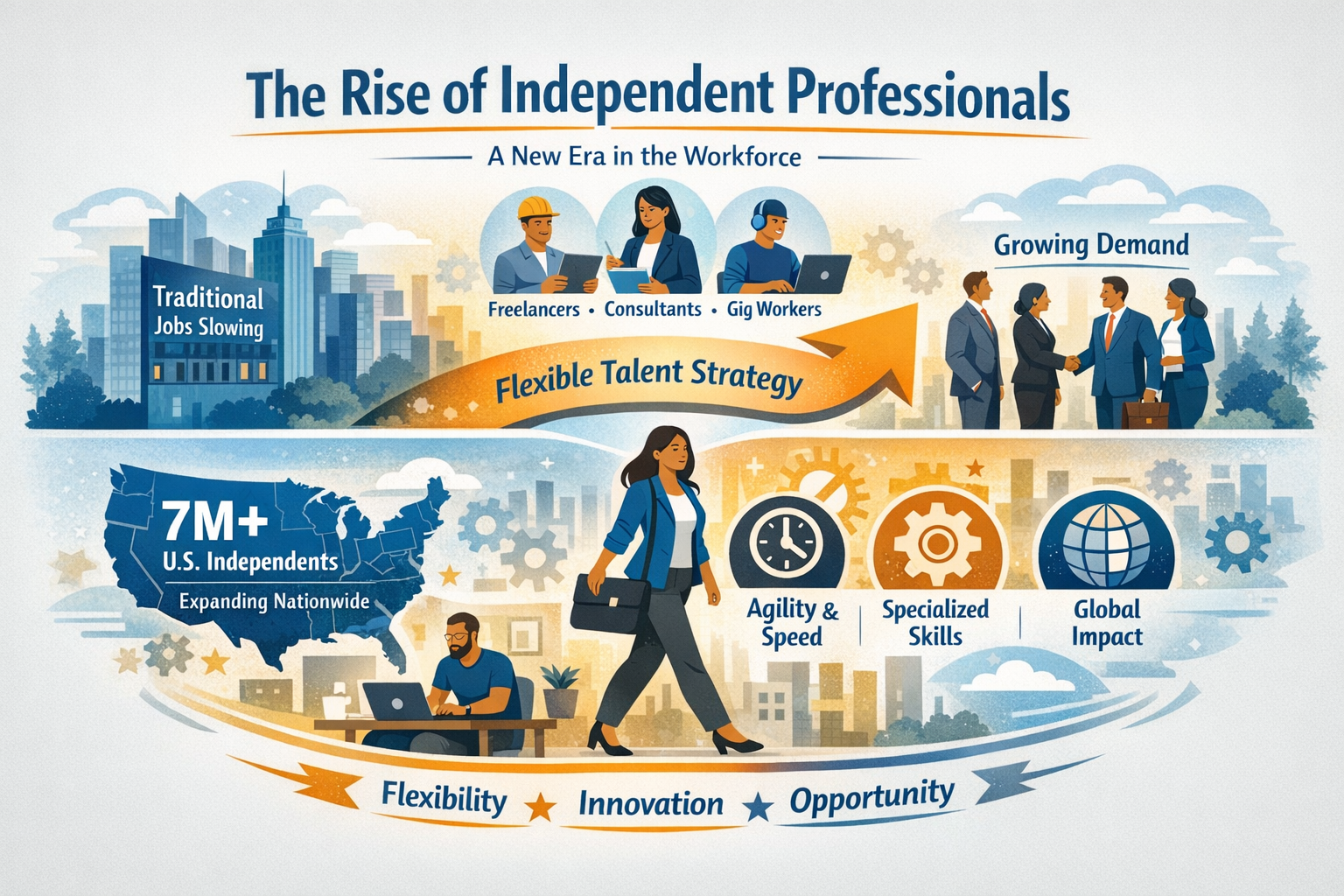
Independent professionals are becoming a core part of modern workforce strategy, not a niche or temporary solution.
-
Demand for independent and extended workforce talent remains strong, even as traditional hiring slows.
-
Companies are increasingly using independent professionals for critical, strategic work — not just short-term gaps.
-
The independent workforce is growing across industries and geographies, with millions of professionals operating nationwide and globally.
-
Independent work offers flexibility and autonomy for professionals, and agility and access to specialized skills for organizations.
-
This shift represents a long-term structural change in how work is organized, and organizations that adapt will gain a competitive advantage.
Over the past several years, independent professionals have steadily moved from the margins of the labor market to its center.
Independent professionals are no longer operating on the fringes of the labor market. Recent data and reporting from the U.S. Bureau of Labor Statistics (BLS) and industry research published over the past two months make it increasingly clear: independent work is no longer a temporary response to economic uncertainty — it is a structural shift in how work gets done.
According to recent BLS employment data, overall payroll job growth has moderated in recent months, reflecting broader economic uncertainty and more cautious hiring by employers. Yet beneath those headline numbers lies a more nuanced story. While full-time hiring has slowed, demand for nontraditional work arrangements — including independent contractors, consultants, and project-based professionals — has remained resilient. Businesses are continuing to rely on flexible labor models to access skills, control costs, and adapt quickly to changing conditions.
This divergence highlights a fundamental shift in workforce strategy. Rather than expanding permanent headcount, many organizations are turning to independent professionals to support core initiatives. Independent talent is increasingly engaged in areas such as technology implementation, digital transformation, operations improvement, and specialized advisory work. These professionals are no longer viewed solely as temporary labor, but as essential contributors to business continuity and innovation.
Recent reporting on the freelance economy reinforces this trend. New research estimates that nearly seven million independent professionals are now operating across the United States, with growth occurring across a wide range of cities and industries. Importantly, this expansion is not limited to traditional freelance hubs or creative fields. Independent work is gaining traction in professional services, technology, finance, healthcare, and operations — signaling its broad relevance across the economy.
Global data tells a similar story. A November 2025 overview of gig and freelance workforce statistics shows that independent work has become a defining element of labor markets worldwide. Millions of professionals are choosing independent careers intentionally, drawn by greater autonomy, flexibility, and control over their time and income. For many, independence is no longer a fallback option, but a preferred career path aligned with personal and professional goals.
From the employer perspective, the appeal is equally strong. Independent professionals offer speed, adaptability, and access to specialized expertise that can be difficult to secure through traditional hiring alone. In an environment where skill requirements evolve rapidly and business priorities shift quickly, flexible talent models provide a level of agility that permanent structures often cannot match.
Taken together, these developments point to a structural transformation rather than a cyclical response to economic conditions. The growing role of independent professionals reflects deeper changes in how work is organized, how careers are built, and how businesses compete. Organizations that continue to rely exclusively on traditional employment models may find themselves constrained by slower hiring cycles and limited access to niche skills.
Independent professionals are not simply supplementing the workforce — they are redefining it. As BLS data and recent research make clear, the future of work will be shaped by organizations that recognize independence as a strategic advantage and integrate it thoughtfully into their talent strategies.