Independent in 2026? Stop Thinking Like an Employee
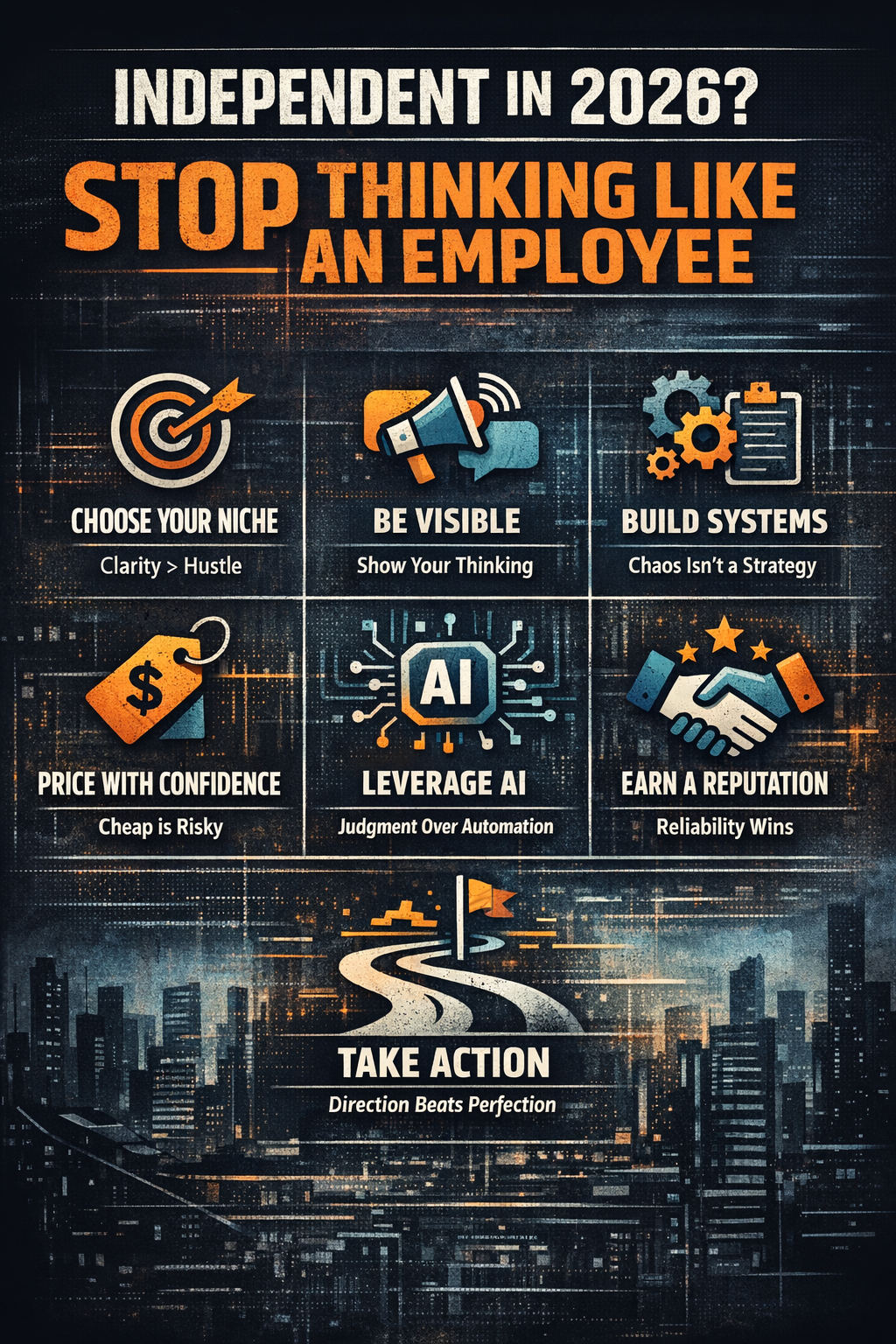
Turning to independent work in 2026 isn’t a new trend. But making the switch without changing how you think is new.
Leaving a traditional job doesn’t automatically make you an independent professional. It requires a mindset shift to do it successfully. Too many people bring employee habits into independent careers—and then wonder why the work feels unstable, underpaid, or exhausting.
Independence today isn’t about freedom from work. It’s about ownership. And ownership demands a different mindset.
Here’s what actually matters if you’re starting out now:
Your First Job Is Not Doing the Work — It’s Choosing the Problem
Employees are assigned roles. Independent professionals choose problems.
If you can’t clearly explain what problem you solve and who it’s for, you’re not being flexible—you’re being forgettable. Clients don’t buy effort. They buy reduced uncertainty.
In 2026, “I can help with anything” is not a value proposition. It’s a warning sign.
The strongest independents don’t chase every opportunity. They commit to a narrow problem, deliver predictable outcomes, and earn trust by doing the same thing well—again and again.
Clarity isn’t limiting. It’s how serious work begins.
Visibility Isn’t Optional Anymore
The credential economy is fading. No one is waiting to discover you.
Clients don’t ask where you went to school or who you worked for. They ask:
-
Do I understand what you do quickly?
-
Have I seen evidence of how you think?
-
Do you seem reliable before I ever speak to you?
If your thinking isn’t visible, your value is theoretical.
You don’t need to become an influencer. But you do need to show your work—your process, your perspective, your lessons learned. Consistency beats polish. Silence kills trust.
Independence Is a System, Not a Personality Trait
If independence feels chaotic, it’s because you’re improvising instead of designing.
Successful independent professionals don’t rely on motivation or grit. They build systems:
-
Clear scopes that prevent scope creep
-
Repeatable onboarding that sets expectations
-
Simple financial discipline that prioritizes cash flow
-
Peer networks that replace the false comfort of hierarchy
Working alone doesn’t mean operating without structure. Freedom comes from constraints you choose, not from saying yes to everything.
Pricing Reveals How Seriously You Take Yourself
New independents underprice themselves because they’re afraid of rejection. But low prices don’t create safety—they create doubt.
Pricing tells clients how to treat you. If you price like you’re unsure, they’ll manage you like you’re replaceable.
In 2026, the fastest way to stall your career is to trap yourself in hourly thinking. Time is not the scarce resource—judgment is.
Professionals who price based on outcomes don’t do it because they’re arrogant. They do it because they understand where their value actually lives.
AI Didn’t Replace You — It Exposed You
AI is everywhere now. That means access is no longer an advantage.
If your value was execution alone, you were already vulnerable.
What clients still pay for is:
-
Judgment when the answer isn’t obvious
-
Context when the data conflicts
-
Accountability when outcomes matter
AI can generate options. Independent professionals are paid to choose—and to own the consequences.
Your job isn’t to compete with tools. It’s to operate at a level where tools are assumed.
Your Reputation Will Scale Faster Than Your Skills
In independent work, reputation compounds quietly—and unforgivingly.
Clients remember:
-
How you handled ambiguity
-
Whether you communicated early or disappeared
-
Whether you made their work easier or harder
Referrals don’t come from networking harder. They come from being dependable.
Reliability is still rare. And in 2026, it’s one of the strongest differentiators left.
You Don’t Need a Perfect Plan — You Need Direction
Waiting to feel “ready” is just procrastination with better branding.
No independent career starts with a five-year plan. It starts with a decision:
-
to commit to a problem,
-
to make your thinking visible,
-
to price with intention,
-
and to improve through real feedback, not theory.
Momentum beats certainty. Every time.
The Bottom Line
Independent work in 2026 rewards professionals who stop asking for permission—permission to specialize, to charge fairly, to be visible, to act like owners.
Independence isn’t the absence of structure. It’s responsibility without a safety net.
And for those willing to accept it, it’s still one of the most powerful ways to build a career on your own terms.