2025: The Year Independence Became a Power Position
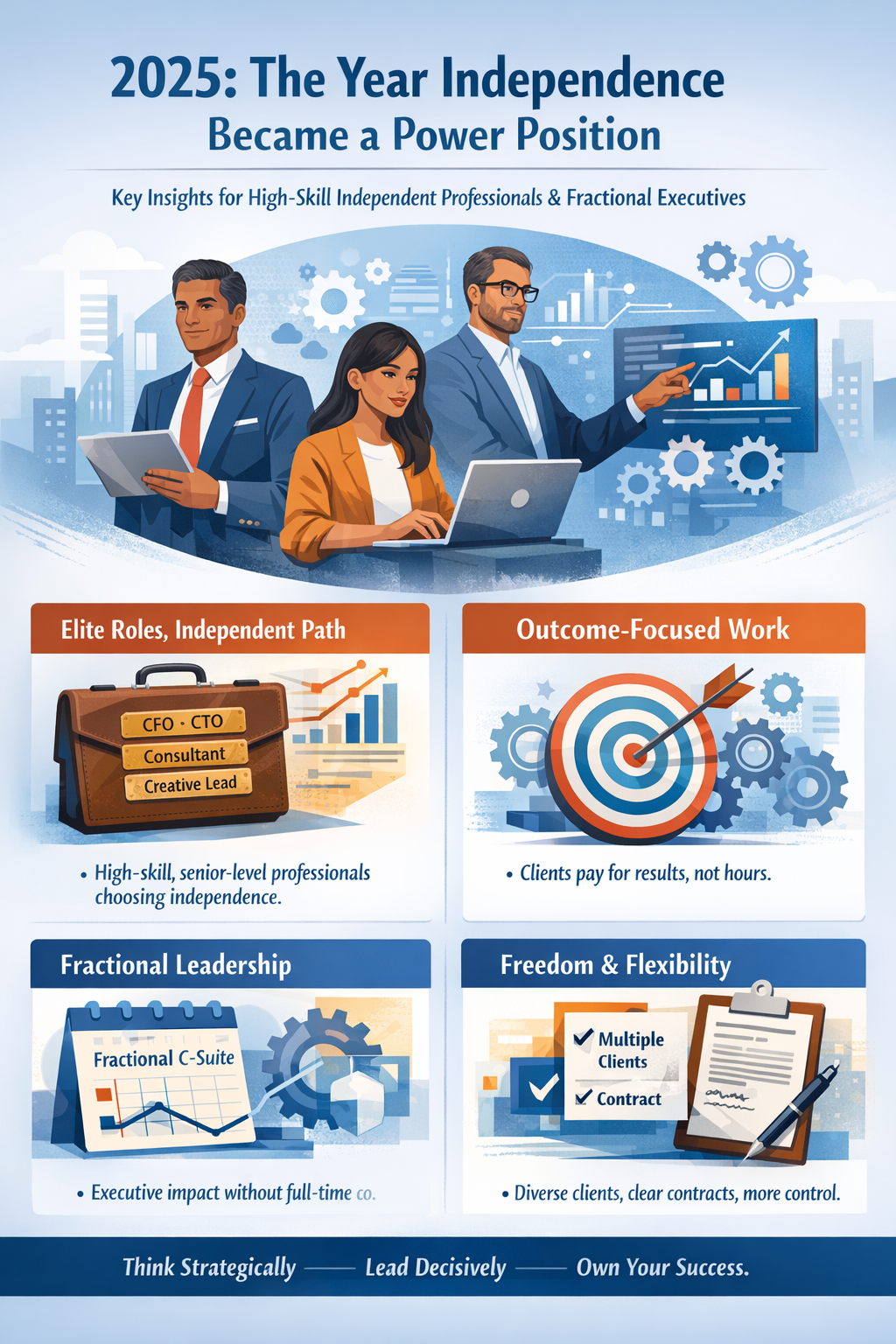
What highly-skilled independent professionals—and fractional executives—learned about leverage, relevance, and control
In 2025, independent work in the U.S. crossed an important psychological line: independence stopped being a compromise and became a competitive advantage.
For senior professionals in software development, engineering, cybersecurity, creative leadership, consulting, project management, accounting, legal services—and increasingly the fractional C-suite—the year confirmed what many already felt: the market is no longer organized around jobs. It is organized around expertise, outcomes, and trust.
Key Takeaways for Independent Professionals (2025)
-
Independence became a power position in 2025, especially for senior, highly compensated professionals in tech, consulting, legal, finance, and creative fields.
-
Independent work moved upmarket: companies now expect senior-level expertise—architecture, judgment, and leadership—to be delivered outside traditional employment.
-
Fractional C-suite roles are a legitimate career lane, not interim stopgaps. Fractional CFOs, CTOs, CIOs, CMOs, and COOs deliver full accountability without exclusivity.
-
Clients pay for outcomes, not hours. AI absorbed routine execution, increasing the value of decision-making, system design, risk ownership, and integration.
-
Authority beats availability. Successful independents define scope, decision rights, and deliverables rather than selling time or constant access.
-
Independence is a business model, requiring positioning, pricing discipline, client selection, and clear boundaries—not just flexibility.
-
Legal enforcement noise mattered less than structure. Professionals with multiple clients, clear scopes, and business-to-business relationships remained well positioned.
-
Noncompete pressure eased, enabling portfolio careers and normalizing mobility for elite independent talent.
-
Optionality replaced job security. Diversified clients and transferable expertise became the new form of professional stability.
-
The future of work is expert-led and hybrid by design, blending employees, independent specialists, and fractional leaders intentionally.
Independence moved upmarket—and stayed there
Senior talent chose independence on purpose
In 2025, highly compensated professionals did not move independent because they were pushed out of employment. They moved because independence offered:
-
Control over scope and priorities
-
Portfolio careers instead of single-employer risk
-
Faster financial upside tied to impact
-
The ability to work on problems that actually matter
Research from the Upwork Future Workforce Index 2025 showed that highly-skilled independent professionals—especially in technology and consulting—reported strong demand and influence on core business initiatives, not just peripheral work.
This marked a structural shift: companies now expect senior-level work to be delivered independently.
Fractional C-suite leadership became a legitimate career lane
One of the clearest signals of 2025 was the normalization of fractional executive leadership.
Fractional CFOs, CTOs, CIOs, CMOs, and COOs were no longer viewed as interim or “bridge” hires. Instead, they were engaged to:
-
Lead transformation without long-term overhead
-
Bring pattern recognition across multiple organizations
-
Provide executive judgment without internal politics
For seasoned leaders, fractional work unlocked a rare combination: authority without captivity.
The professionals who thrived treated fractional roles as businesses, not titles:
-
Clear mandates
-
Defined decision rights
-
Outcome-based compensation
-
Multi-client portfolios by design
AI clarified what clients actually pay for
By 2025, AI stopped being a novelty and became infrastructure. The result was not fewer independent professionals—but a sharper sorting mechanism.
AI absorbed:
-
Repetitive execution
-
Documentation and synthesis
-
First-pass analysis
What clients paid for instead:
-
Architecture and system design
-
Risk judgment
-
Integration across teams and tools
-
Accountability for results
Independent professionals who framed their value around thinking, judgment, and ownership saw higher rates and tighter scopes. Those who sold hours or tasks felt margin pressure.
Key shift: Independence rewards professionals who sell decisions and outcomes, not effort.
The legal environment mattered less than how you worked
Enforcement softened—but structure still ruled
In May 2025, the U.S. Department of Labor paused active enforcement of the 2024 independent-contractor rule while reviewing it. For highly-skilled professionals, this reduced short-term anxiety—but it did not change the fundamentals.
Well-run independent practices already aligned with what regulators care about:
-
Control over how work is performed
-
Multiple clients
-
Clear scopes and deliverables
-
Business-to-business relationships
Contract culture shifted in your favor
Ongoing scrutiny of noncompete clauses—following the Federal Trade Commission’s 2024 rulemaking—continued to reshape contracts in 2025. Many organizations narrowed or removed restrictions, enabling:
-
Portfolio careers
-
Faster transitions between engagements
-
Greater independence at senior levels
The result: mobility became normalized for elite professionals.
What 2025 taught successful independent professionals
1. Independence is a business model, not a work arrangement
The most successful independents operated with:
-
Positioning
-
Pricing strategy
-
Client selection criteria
-
Clear boundaries
2. Authority beats availability
Clients valued professionals who took responsibility, not those who stayed “on call.”
3. Fractional does not mean partial
Fractional leaders delivered full accountability—just not full exclusivity.
4. Optionality is the new security
Multiple clients, diversified revenue, and transferable expertise replaced the illusion of job security.
The bigger picture
2025 confirmed that independence—especially at the senior and executive level—is no longer fringe. It is how expertise moves through the U.S. economy.
For independent professionals, the opportunity is not just to participate—but to define the terms.
The next phase is not about proving independence works.
It’s about building careers—and businesses—that assume it does.